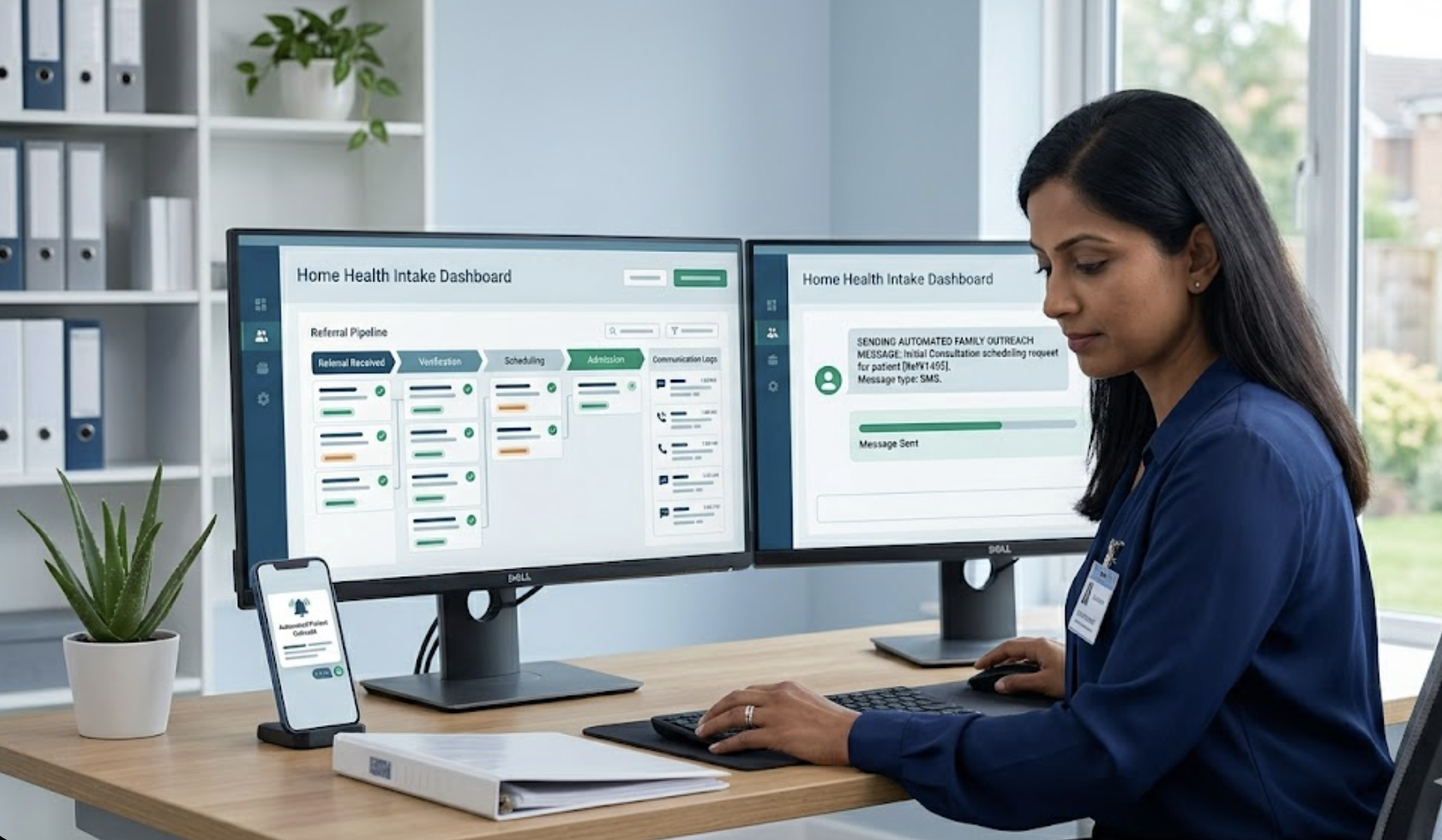
When home health agencies experience admission delays, the instinct is often to look at the intake team first: staffing levels, response times, and workflow training. In many cases, however, the team is performing well. The bottleneck is in the communication infrastructure around them, and it tends to be invisible until you know where to look.
Referral sources, hospital discharge planners, Physicians, and case managers make decisions about which home health agency to call based on speed and responsiveness. When a referral goes unanswered for four hours, or when a family member cannot get a clear status update on when a Nurse will arrive for the first visit, that experience shapes whether the next referral comes to your organization or to a competitor.
The gap between a well-trained intake team and a fast, responsive admission process is often not a people gap. It is a workflow and communication infrastructure gap. Understanding where that friction lives is the starting point for addressing it.
These figures are drawn from industry surveys and published reporting and reflect patterns across a range of organization sizes and structures. Methodology and sample composition vary by source, and actual experience will differ depending on referral mix, staffing model, geographic market, and existing workflow infrastructure. What they consistently point toward, however, is that admission timeline issues tend to have a strong internal communication component, and that component is frequently underweighted when agencies diagnose the root cause of delays.
Admission delays in home health rarely trace back to a single bottleneck. They are more often the product of several smaller friction points compounding across the intake workflow. The table below maps common workflow stages against the communication gaps that tend to slow them down. This is a starting framework for identifying where your organization's friction may be concentrated, not a comprehensive operational audit.
| Workflow stage | What typically happens | Where communication friction appears |
|---|---|---|
| Referral receipt | Intake Coordinator receives referral via fax, phone, or portal | Referral sits unacknowledged while Coordinator is on another call; no automated confirmation sent to referral source |
| Eligibility and insurance verification | Coordinator routes to verification staff or external payer | Internal handoff relies on email or verbal communication with no tracking; status updates require manual follow-up |
| Physician order request | Clinical staff contact ordering Physician for start-of-care orders | Physician outreach runs through personal cell phone calls and fax; follow-up on outstanding orders is manual and time-consuming |
| Patient and family notification | Intake or clinical staff contact patient or family to confirm admission and schedule first visit | Outreach is manual, often delayed by staff availability; families report difficulty reaching the agency for status updates |
| First visit scheduling | Scheduler assigns Nurse for start-of-care visit | Scheduling confirmation to patient or family is delayed or inconsistent; Nurse may not have complete patient context before the visit |
Each of these friction points is individually manageable. What makes them organizationally significant is that they tend to occur simultaneously across multiple active referrals, and the cumulative delay compounds. A referral that experiences three of these friction points in sequence may arrive at the first visit window four to six hours later than it would have with structured communication support at each stage. For referral sources tracking agency responsiveness, that difference is often material.
Industry reporting from Home Health Care News (2024) suggests that hospital discharge planners and case managers typically evaluate home health agencies on a short list of criteria, with responsiveness to referrals ranking consistently at or near the top of their criteria. Clinical quality matters, but it is difficult for a discharge planner to assess directly in the moment. Speed and communication quality tend to be the most immediately visible signals.
What referral sources tend to experience when communication infrastructure is fragmented:
Each of these experiences tends to reduce the likelihood that the referral source directs the next referral to the same agency. The relationship between referral source confidence and admission volume is well-documented in industry reporting, and communication quality is consistently identified as one of the more actionable levers available to agencies looking to strengthen it.
In many home health markets, the patient or family has meaningful input into which agency is selected. When a family member has a poor experience in the first 24 to 48 hours of the admission process, including difficulty reaching anyone at the agency for status updates, that experience can influence whether the admission proceeds, whether the family requests a different agency, or whether they share that experience with the referral source.
Research from Becker's Healthcare (2024) indicates that a meaningful share of home health admission cancellations or redirections occur during the pre-admission window, before the first clinical visit, and that family communication quality during that window is a contributing factor in a notable portion of those cases. Agencies that have implemented proactive, automated patient and family outreach during the admission process tend to report fewer cancellations in the pre-admission period and stronger first-visit completion rates, though outcomes vary by organization and market.
In practice: the referral that quietly walks away
A hospital discharge planner sends a referral for a 74-year-old patient being discharged the following morning. The referral arrives at 2:15 PM. The Intake Coordinator is on a call. The referral is noted but not actioned until 3:40 PM.
The Coordinator attempts to reach the patient's daughter to confirm the admission and schedule the start-of-care visit. No answer. A voicemail is left. The Coordinator moves to the next referral. No follow-up is scheduled automatically.
The patient's daughter calls the agency at 5:00 PM, reaches a general line, and is told someone will call her back. The callback does not come before the office closes. By 8:00 AM the next morning, the family has called a second agency and requested that the discharge planner redirect the referral.
The original agency's intake team did not make a clinical error. The admission was lost to a communication and follow-up infrastructure gap that is difficult to detect in standard reporting, because the referral showed as received and in progress at every stage. Nothing in standard intake tracking flagged it as at risk.
This kind of scenario tends to be undercounted in agency reporting because the referral showed as received and in progress at every stage. The loss surfaces only in retrospect, often attributed to competitive preference or patient choice, when the actual driver was a follow-up gap that the reporting system never captured. Agencies that have mapped this pattern in their referral data frequently find that a meaningful portion of what appears as competitive loss is attributable to pre-admission communication friction that was invisible in real time.
Organizations that have addressed admission communication infrastructure at the workflow level tend to see a consistent set of operational improvements. The degree of improvement varies by starting point, organization size, and referral mix, but the directional pattern is fairly consistent:
When admission delays are rooted in communication infrastructure rather than team capacity or clinical process, addressing them at the infrastructure level is typically more effective than adding staff or increasing oversight. The workflow and behavior changes that improve admission speed and referral source relationships tend to require tooling that supports them, not just policy that requires them.
This is where purpose-built communication infrastructure becomes operationally relevant. The organizations that have made meaningful progress on admission timelines are typically those that have moved beyond relying on email, voicemail, and personal cell phone calls as the connective tissue of their intake workflow, and built a communication layer that supports the speed and accountability the admission process requires.
QliqSOFT's Quincy enables home health agencies to automate proactive outreach to patients and families at key points in the admission process, including referral receipt confirmation, admission status updates, first visit scheduling notifications, and pre-visit preparation reminders. Outreach is personalized, documented, and delivered through a HIPAA-compliant channel. Families receive timely information without requiring manual Intake Coordinator effort at each touchpoint, and the agency builds a documented outreach record that supports both the referral source relationship and internal accountability.
QliqSOFT's QliqCHAT supports the internal coordination side of the admission process by giving Intake Coordinators, Schedulers, Nurses, and Care Coordinators a shared, HIPAA-compliant communication channel for referral handoffs, eligibility status updates, Physician order tracking, and first visit coordination. Internal handoffs become visible and trackable rather than dependent on email chains and verbal follow-up. When a referral changes status or a new piece of clinical information arrives, the relevant team members receive it through a structured channel rather than discovering it during a status call.
Together, Quincy and QliqCHAT address the admission communication gap from both sides: the external relationship with patients, families, and referral sources, and the internal coordination among the intake and clinical team. The combination is designed to support a faster, more accountable admission process without requiring additional headcount to manage the communication volume. Results will vary by organization, referral mix, and existing workflow infrastructure.
Connect with the QliqSOFT team to walk through how Quincy and QliqCHAT support faster, more reliable home health admissions in your operating environment.
Request a DemoIndustry references: Home Health Care News (2024): Referral responsiveness, intake delays, and agency selection patterns in home health. Becker's Healthcare (2024): Patient access bottlenecks and pre-admission communication in home-based care. National Alliance for Care at Home (2024): Intake and referral workflow resources and home health operations benchmarks.
In many cases, home health referrals are lost not because the intake team performed poorly, but because the communication infrastructure around the intake process created gaps that were invisible in standard reporting. A referral can show as received and in progress while the patient's family is simultaneously not hearing back and reaching out to a second agency. The most common points where this occurs include delayed family notification after referral receipt, no automated acknowledgment to the referral source, manual follow-up systems that depend on individual staff recall, and Physician order tracking that relies on personal cell phone calls rather than a structured communication channel. Agencies that have mapped this pattern in their referral data frequently find that a meaningful share of what appears as competitive loss is attributable to pre-admission communication friction that was never flagged in real time.
Industry surveys suggest that internal communication delays, rather than patient availability or staff competency, are among the most commonly cited drivers of admission timeline slippage in home health. The friction tends to accumulate across several workflow stages simultaneously: referral acknowledgment, eligibility verification handoffs, Physician order follow-up, patient and family notification, and first visit scheduling coordination. Each stage typically relies on email, voicemail, and personal cell phone calls rather than a structured, trackable communication channel. When multiple active referrals are moving through these stages at the same time, the cumulative delay compounds in ways that are difficult to detect without visibility into where each referral is in the process at any given moment.
Research from Becker's Healthcare (2024) indicates that a meaningful share of home health admission cancellations and redirections occur during the pre-admission window, before the first clinical visit, and that family communication quality during that window is a contributing factor in a notable portion of those cases. When a family does not receive a timely status update after a referral is submitted, they may contact the agency repeatedly, reach a general line without access to relevant information, or lose confidence and request redirection to a different agency. The challenge is that this dynamic tends not to appear in standard intake reporting because the referral was received and appeared to be in process. Agencies that have implemented proactive, automated family outreach at key admission touchpoints tend to report fewer pre-admission cancellations, though outcomes vary by organization, market, and referral mix.
A structured admission communication workflow typically addresses both the external relationship with patients, families, and referral sources and the internal coordination among intake and clinical staff. On the external side, it includes automated confirmation to the referral source at receipt, proactive outreach to the patient and family following referral acceptance, visit scheduling notifications, and pre-visit preparation reminders, all delivered through a HIPAA-compliant channel and documented automatically. On the internal side, it includes a shared, trackable communication channel for referral handoffs, eligibility status updates, Physician order tracking, and first visit coordination, so Intake Coordinators and supervisors can see where active referrals are in the process without making status calls. The goal is to make the admission process faster and more accountable without requiring additional headcount to manage the communication volume.
Industry reporting from Home Health Care News (2024) suggests that hospital discharge planners and case managers evaluate home health agencies significantly on responsiveness, with communication quality being one of the most immediately visible signals available to them. Agencies looking to reduce referral source attrition from communication delays tend to focus on three areas: first, automating referral acknowledgment so the referral source receives a confirmation before a staff member has manually reviewed the referral; second, ensuring that family communication during the pre-admission window is proactive and documented rather than reactive and informal; and third, building internal handoff visibility so that when a referral source calls for a status update, the Intake Coordinator can provide an accurate answer immediately rather than spending time locating the information. The combination of faster external responsiveness and more reliable internal coordination tends to strengthen the referral source relationship over time, though the degree of improvement will vary by organization, market, and referral mix.


Krishna Kurapati is the Founder and CEO of QliqSOFT. He has more than two decades of technology entrepreneurship experience. Kurapati started QliqSOFT with the strong desire to solve clinical collaboration and workflow challenges using artificial intelligence (AI)-powered digital technologies across the U.S. healthcare system.

Reach Your Patients
Like Your Portal Never Could


%20(1).png)