
Real-time text translation is reshaping how health systems communicate with patients, turning every message into an opportunity for safer, more accessible care.
U.S. healthcare serves one of the most linguistically diverse populations in the world, yet language access still trails clinical needs in everyday practice. An estimated 25.6 million people in the United States have limited English proficiency (LEP), which is roughly 8–9% of the population across hundreds of spoken and signed languages. LEP is closely linked to lower insurance coverage, reduced access to primary care, and gaps in preventive services.
Patients with LEP are more likely to misunderstand instructions, medication regimens, and follow-up plans, which in turn drives avoidable ED visits and poorer outcomes in conditions such as cancer, asthma, diabetes, and hypertension.
Language barriers do not affect only what occurs in the exam room; they also make simple tasks such as scheduling visits, refilling prescriptions, and navigating benefits significantly more difficult. When those barriers go unaddressed, delays in care, higher hospitalization rates, readmissions, and increased mortality are inevitable.
Although federal civil rights law and the National CLAS Standards require timely, no-cost language assistance and easy-to-understand materials, interpreter services are still inconsistently provided in routine encounters. Many organizations continue to rely on ad hoc interpreters, family members, or untrained staff despite regulatory guidance discouraging such practices, thereby increasing clinical risk and undermining patient trust.
Operational reality plays a big role. Traditional interpreter models are synchronous, resource-intensive, and expensive, making them difficult to deploy for high-volume, low-acuity touchpoints such as reminders, pre-visit screening, and post-discharge check-ins. Front-line teams are left balancing regulatory expectations for language access against workforce shortages and productivity pressure, which often leads to inconsistent interpreter use and fragmented communication for LEP patients.
Patients who speak uncommon languages face even steeper obstacles in accessing qualified healthcare interpreters, which can delay or compromise care. For many rare languages, there are very few trained medical interpreters available, which means support often requires scheduling appointments days or weeks in advance rather than on-demand access aligned with clinical workflows.
Rural and smaller facilities struggle the most, as speakers of rare languages are frequently concentrated in resource-constrained regions with limited interpreter coverage. Even where interpreter contracts exist on paper, hospitals tend to prioritize high-volume languages, leaving rare-language speakers dependent on family or partially bilingual staff, precisely the scenario that increases the risk of medical errors and miscommunication.
Maintaining on-site interpreters or specialty agency contracts for low-volume languages can also be prohibitively expensive, thereby encouraging underinvestment and leaving organizations exposed to language access compliance risks.
Traditional interpreter services are clinically essential but structurally expensive. On-site certified medical interpreters often cost $100–140 per hour, with typical hospital estimates ranging from about $45 to $150 per hour, plus travel, and many vendors enforce three-hour minimums. Video remote and phone interpreting are more flexible but are usually billed per minute, with standard price bands of $1.95 to $4 per minute and minimum time commitments.
Those economics make it difficult to extend human interpreters into the “long tail” of everyday communication, such as status updates, simple instructions, or quick questions that may not justify a full interpreted encounter. The result is a familiar gap: pristine compliance on paper for high-stakes moments, and inconsistent, sometimes unsafe improvisation for everything else.
Real-time text translation helps close that gap by making language access continuous rather than episodic. Secure patient texting with real-time text translation turns each message, no matter how routine, into a clinically meaningful touchpoint for patients who would otherwise be excluded. When HIPAA-compliant messaging is combined with instant language support, organizations can improve safety and access while easing the burden on clinical staff.
Instead of scheduling a three-way call every time a patient has a question, clinicians can exchange asynchronous, translated messages that patients read in their preferred language and staff view in English. Real-time text translation is always on and available 24/7, which is exactly when patients need help: at home, between visits, and outside standard business hours.
For patients, secure texting with real-time text translation feels like finally being invited into their own care conversation. Immediate, language-appropriate messages remove the friction and delays that make interpreter workflows unusable for day-to-day communication, while providing continuous access at a fraction of the cost of human interpreters.
Better access to real-time text translation improves understanding of instructions, medication schedules, and follow-up plans, thereby reducing avoidable ED visits and preventable complications. Importantly, patients feel respected and heard when outreach is delivered in their own language, which builds trust, high satisfaction scores, and increases their willingness to engage digitally with the care team.
From the clinician’s perspective, real-time text translation transforms language access from a scheduling problem into a workflow feature. Asynchronous, secure texting allows staff to answer questions between tasks rather than scheduling a live interpreter session for every interaction, thereby preserving interpreters for high-value encounters.
Accurate, translated instructions reduce misunderstandings, support medication adherence, and help patients follow pre- and post-op protocols, thereby lowering the risk of complications and readmissions. Over time, the combination of fewer unnecessary escalations and improved adherence directly affects quality metrics and value-based performance.
At the organizational level, AI-based medical translation and interpretation can reduce interpreter-related costs by an estimated 40–70% relative to exclusive reliance on remote or in-person interpreters.
Modern multilingual texting platforms report dramatic engagement gains when real-time text translation is used consistently, including triple-digit increases in response rates and substantial reductions in no-show rates when instructions and reminders arrive in patients’ native languages.
Once the infrastructure is in place, the marginal cost of translating one more secure text message is nearly zero, enabling unlimited multilingual reminders, follow-ups, and education without worrying about per-minute or per-hour interpreter charges.
Real-time text translation is not a replacement for human interpreters, nor should it be treated as such. AI-driven tools excel in high-volume, low-risk, and routine interactions—appointment reminders, simple instructions, post-visit check-ins, and health education messages — where the primary goal is comprehension rather than nuanced, emotionally charged dialogue.
Human interpreters remain indispensable for high-risk communication, such as surgical consent, serious news, end-of-life discussions, and complex shared decision-making, where nuance, cultural context, and patient preferences carry significant weight.
The strongest model is hybrid: reserve human interpreters for critical encounters and rely on secure patient texting with real-time text translation for the continuous, everyday communication that defines the bulk of a patient’s journey.
The QliqSOFT end-to-end digital communication platform incorporates real-time text translation with patients, enabling HIPAA-secure communication without adding new apps or manual workflows.
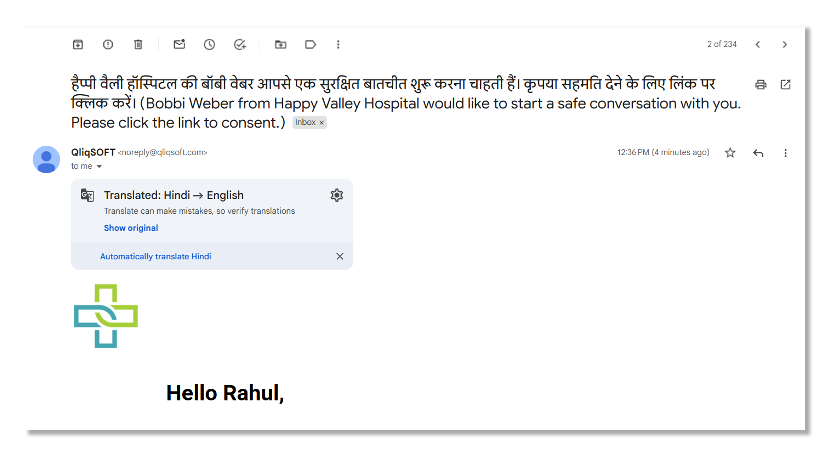
Real-time text translation is no longer a “nice to have” add-on—it is quickly becoming core infrastructure for modern, patient-centered communication. By embedding real-time text translation directly into QliqSOFT’s secure digital workflows, organizations can finally offer always-on language access without sacrificing efficiency, compliance, or clinical quality.
With support for up to 180+ languages across email and mobile, care teams can reach patients where they are, in the language they understand, while maintaining complete visibility into both original and translated messages.
The result is a scalable, sustainable way to close language gaps, preserving human interpreters for critical moments while relying on real-time text translation to keep every patient connected, informed, and engaged between visits.


Bobbi serves as Vice President of Marketing and Customer Success at QliqSOFT. She is a lifelong learner who is passionate about enabling healthcare transformation. She has 20+ years of healthcare experience in care delivery, consulting, healthcare IT, and market strategy.


© 2026 QliqSOFT, Inc. All Rights reserved





%20(1).png)
