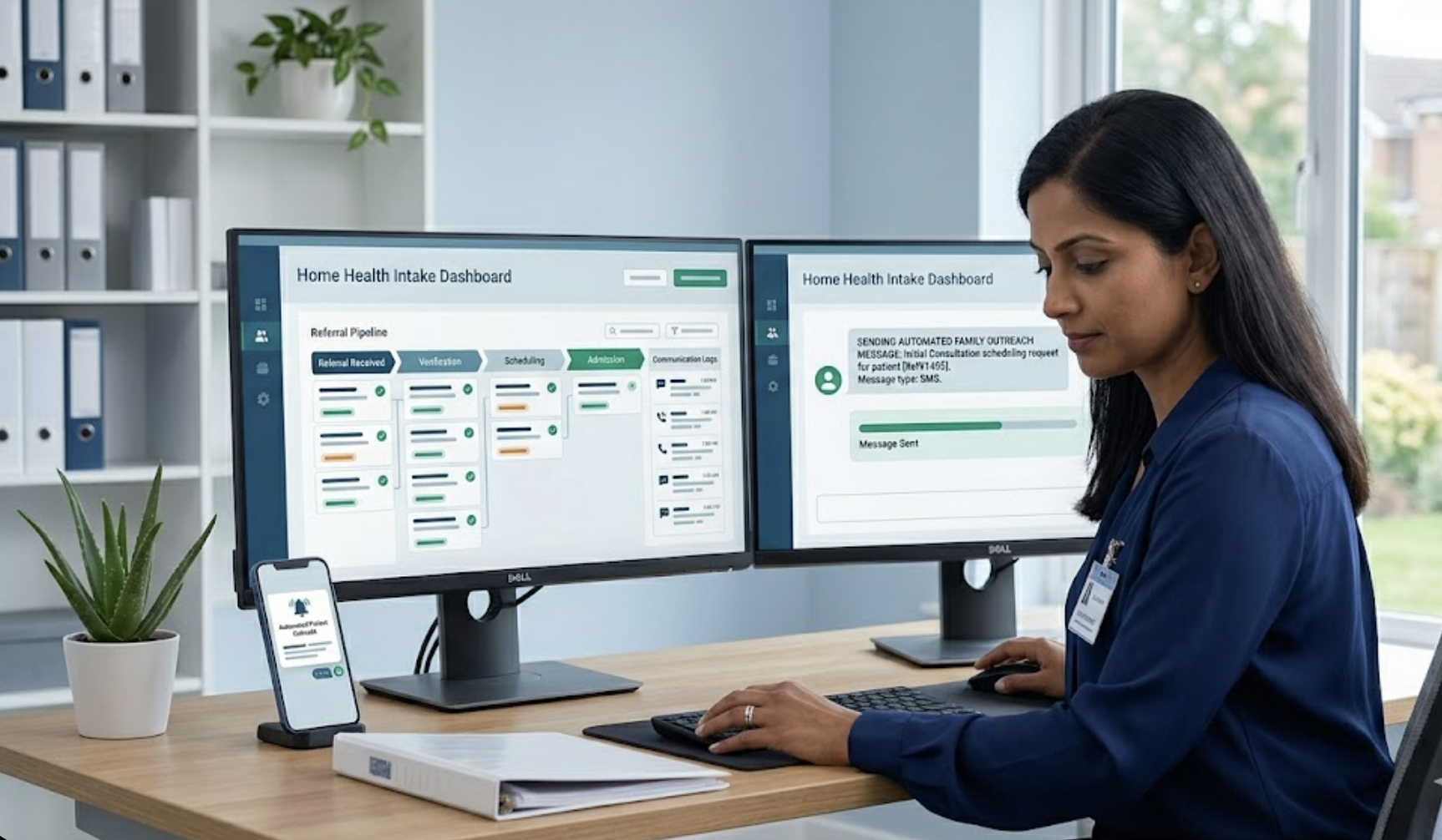
8 Referral Intake Tools for Faster Home Health & Hospice Admissions
For many home health and hospice agencies, the best referral intake software is a combination of tools, not one product. Agencies often keep intake inside their EMR and add tools for the steps that slow them down: sorting referrals, retyping documents, getting family signatures, and answering after-hours calls.

This guide compares eight tools, from EMR referral hubs and AI referral intake platforms to family engagement tools, and shows how to choose the right mix for your agency.
TL;DR: EMR referral hubs and AI referral intake platforms speed up referral processing. Family engagement tools speed up consents, election forms, and the hospice election statement addendum. Choose based on where your intake slows down, and ask each vendor how its tool gets data into your EMR.
QliqSOFT makes one of the tools on this list. We compared the others using each vendor's published materials and did not test them hands-on.
What Is Referral Intake Software for Home Health and Hospice?
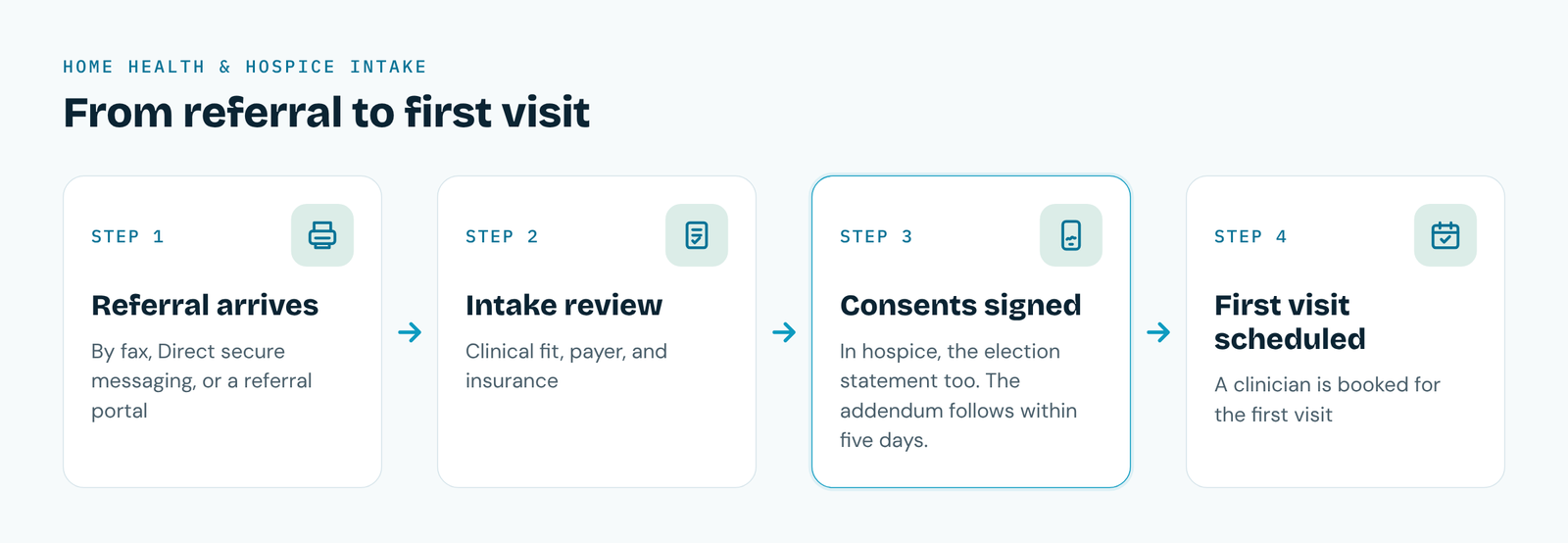
Referral intake software for home health and hospice handles the first part of admissions: receiving referrals, pulling out the details, and checking eligibility. It's one piece of a broader intake workflow that runs from referral to first visit, usually in four steps:
- A referral comes in by fax, Direct secure messaging, or a referral portal.
- The intake team reviews it for clinical fit, payer, and insurance.
- The patient or family signs consents. In hospice, the patient or their representative also signs the election statement, and the addendum follows within the first five days after the election takes effect.
- A clinician is scheduled for the first visit.
Why Every Hour of Intake Counts
In home health, a registered nurse has to make the initial assessment visit within 48 hours of the referral or the patient's return home, or on the start-of-care date ordered by the physician or allowed practitioner (42 CFR 484.55). When therapy is the only service ordered, the appropriate rehabilitation professional may make this visit instead. In hospice, the initial assessment is due within 48 hours after the patient elects hospice (42 CFR 418.54).
The median hospice stay was 19 days in 2024, and more than a quarter of patients enrolled only in their last week of life (MedPAC, March 2026). The election statement may also be signed by an authorized representative (42 CFR 418.24), who may live in another state.
What the Hospice Election Statement Addendum Rule Requires
Starting with hospice elections on or after October 1, 2026, every Medicare patient gets the election statement addendum, not just those who ask for it (FY 2027 Hospice final rule). The addendum lists the items, services, and drugs the hospice won't cover because they're unrelated to the terminal illness.
The hospice has five days from the election's effective date to provide it in writing (42 CFR 418.24). The patient or representative signs and dates it to confirm they received it, not that they agree. If they won't sign, the hospice notes why. It isn't required if the patient dies, revokes, or is discharged before it has to be provided, though the hospice documents the reason. And if a change to the plan of care affects what's covered, the addendum has to be updated within three days.
CMS has said an electronic election statement and addendum are fine as long as the content rules are met, and families can still ask for a paper copy (FY 2021 Hospice final rule).
8 Home Health and Hospice Referral Intake Tools Compared
We chose tools built for home-based care that cover at least one intake step and describe it in their own published materials. Three of them, AutomationEdge, ExaCare, and Lime, are AI referral intake platforms that read referral documents and check eligibility. We've listed QliqSOFT first because it's our product, and noted where it differs from referral automation tools.
| Tool | Type | Steps covered | Best fit for |
|---|---|---|---|
| QliqSOFT | Family engagement and after-hours calls | 1 (after-hours referral calls), 3, 4 (visit reminders only) | Agencies whose intake slows down at the family step |
| HCHB Intake Central | EMR referral hub | 1, 2 | Agencies on Homecare Homebase |
| WellSky CarePort Referral Intake | EMR referral hub | 1, 2 | Post-acute providers receiving referrals through several channels |
| Axxess | EMR feature | 3 | Hospices on Axxess |
| Mosai (formerly Forcura) | Referral and document workflow | 1, 2 | Referral and document workflow in one platform |
| AutomationEdge Referral CareFlo AI | AI referral intake | 1, 2 | Automating referral review |
| ExaCare | AI referral intake | 1, 2 | Screening referrals against eligibility and payer rules |
| Lime | AI referral intake | 1, 2 | Automating referral data entry |
1. QliqSOFT
Quincy by QliqSOFT sends intake packets, consents, and election forms by text. Families complete them on any phone, in their own language, with no app to download. Known fields are prefilled from the EMR. QliqSOFT's AI Voice Agents answer after-hours referral calls, capture the details, and route the caller to the clinician on call. Families also get visit reminders by text, and Snap to PDF in the QliqCHAT app lets liaisons capture a referral packet at the bedside straight into the patient's thread.
Walla Walla Community Hospice saw a 30 percent reduction in patient intake time with QliqSOFT. Reading referral packets and checking eligibility are jobs for a referral hub or an AI referral intake tool, so pair QliqSOFT with one of those.
2. HCHB Intake Central
Homecare Homebase describes Intake Central as a way to centralize referrals, automate manual work, and see conversion, cycle time, and bottlenecks. Kno2 connectivity and AI-assisted extraction fill in referral fields automatically.
Watch for: it's built into Homecare Homebase, so it's mainly a fit for agencies already on HCHB.
3. WellSky CarePort Referral Intake
WellSky says CarePort Referral Intake takes referrals from eFax, Direct messaging, and portals and puts them on one worklist. It uses AI to pull out patient, admission, and insurance details (WellSky, March 2026).
Watch for: it's a WellSky product, so ask how it works if your EMR isn't WellSky.
4. Axxess
Axxess Hospice lets agencies upload, manage, and track electronic consent forms and other documents patients must sign before hospice care starts. Patients can also sign the election statement electronically on a clinician's Android device.
Watch for: this is a feature inside Axxess Hospice, not a separate tool, so it's only an option if you run Axxess.
5. Mosai (formerly Forcura)
Forcura and Medalogix merged in 2025 and rebranded as Mosai (Hospice News). Its referral and admissions products are Mosai Referrals and Mosai Review.
Watch for: after the rebrand, ask which former Forcura and Medalogix features your package includes.
6. AutomationEdge Referral CareFlo AI
According to AutomationEdge, Referral CareFlo AI automates referral intake for home health, hospice, and skilled nursing. It pulls in referral data, checks whether the referral fits your services, runs insurance eligibility checks, and adds accepted referrals to the EMR.
Watch for: it serves skilled nursing too, so ask for references from an agency like yours.
7. ExaCare
ExaCare's platform puts referrals from hospital portals, referral platforms, and eFax in one inbox. On a hospice referral, it reads the documents against CMS eligibility guidelines and points out what's missing, such as a face-to-face encounter. Payer and service area get checked too, and accepted patients go to the EHR.
Watch for: confirm it connects to your EHR before you book a demo.
8. Lime
Lime describes its intake automation as parsing referral PDFs and faxes, verifying payer eligibility, and drafting admission notes for home health and hospice.
Watch for: Lime also sells an OASIS scribe and its own EMR, so ask whether intake works on its own.
Estimate the cost of intake delays with the ROI calculator on our digital forms page.
Example: From Fax to First Visit
Here's how a single hospice referral might move through a connected setup. This is an illustrative example, not a real agency.
- Saturday, 2:30 PM. A hospital faxes a referral, and the referral intake tool pulls out the patient and insurance details.
- 3:00 PM. The intake nurse confirms eligibility and accepts.
- 3:15 PM. Consents and the election statement go by text to the patient's daughter, who is her legal representative. She signs from her phone that afternoon.
- 9:00 PM. She calls with a question about medications. An AI voice agent picks up and puts her through to the nurse on call.
- Sunday morning. A text tells the family when the nurse will arrive. Everything is already signed and, with the EMR integration set up, in the patient's record.
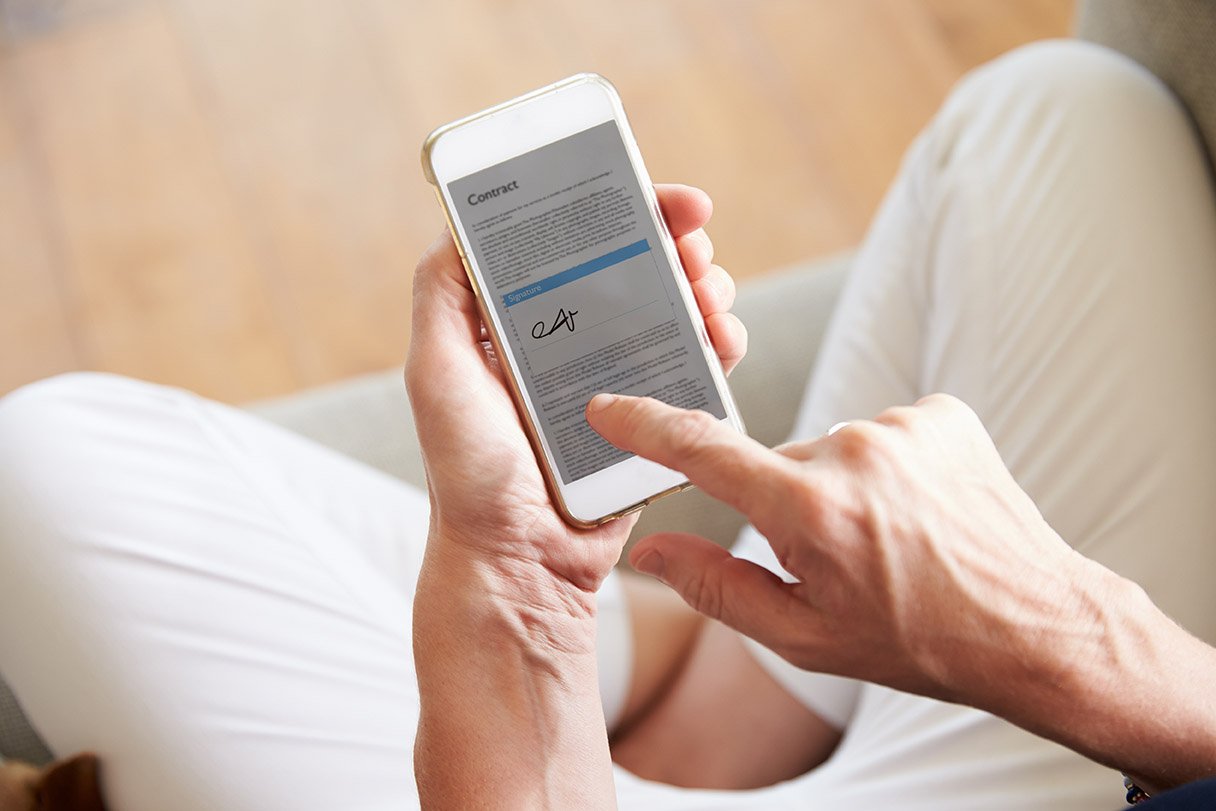
Without the family step, those signatures might have waited for a weekday office visit.
How Do You Choose the Right Referral Intake Software?
Time each intake step for your last 20 referrals. A backed-up referral queue calls for a referral hub or AI referral intake. If referrals sit waiting for signatures, a family engagement tool is the better fix.
Ask vendors what data goes into your EMR, what comes back out, and how often. Then pilot with one referral source or branch and compare the numbers with your baseline.
Key Capabilities to Look For
A quick checklist for comparing vendors:
- EMR connection: the information you need gets into your EMR without anyone typing it twice.
- Referral tracking: you can see referral volume, conversion, and time to admission.
- Mobile signing: families sign consents, and the patient or representative signs the election statement and addendum, from a phone with no app.
- Language and prefill: forms open in the family's language with known details already filled in.
- Visit reminders: families get a text before the first visit.
- After-hours coverage: a referral call at 10 PM reaches someone, not voicemail.
- Security: a signed BAA, encryption, role-based access, and audit trails.
Common Intake Mistakes to Avoid
A common mistake is choosing software that doesn't address the actual intake bottleneck. If admissions are held up by family signatures, a faster referral queue won't fix that.
Smaller gaps cause delays too. Nobody owns the addendum. Referral calls sit in voicemail overnight. A family misses the first visit because no one reminded them. Any of these can push you up against the 48-hour window.
Check How Each Tool Connects to Your EMR
The EMR stays the system of record, and the best intake tools send their results back to it. With QliqSOFT, signed documents and form responses flow back to the patient record. QliqSOFT works with Homecare Homebase, MatrixCare, WellSky, and Axxess through HL7, FHIR, and SFTP/CSV, and RPAplus covers EMRs without a usable API. See our Integrations page.
HIPAA Compliance Takes More Than Software
No software makes an agency HIPAA compliant on its own. Your policies and how well staff follow them matter just as much. With QliqSOFT, a BAA comes with every customer relationship, the platform has encryption, role-based permissions, and audit trails, and it's SOC 2 Type II attested.
Pricing: Expect a Quote After a Demo
Most vendors here don't publish prices. QliqSOFT prices per staff seat and per actively engaged patient. See how QliqSOFT pricing works.
Frequently Asked Questions (FAQs)
What is the difference between referral intake software and referral management software?
The terms overlap, and vendors use them differently. Referral management usually means tracking referrals and referral sources over time. Referral intake means processing each new referral: capturing it, pulling out the details, and checking eligibility.
Can a family member sign the hospice election statement?
Only if they are the patient's representative: someone with authority under state law, such as a legal guardian, to act for a patient who can't sign. Federal rules allow that representative to sign it (42 CFR 418.24). Check your state's rules on who can act as a representative.
Is the hospice election statement addendum required for every patient?
For elections on or after October 1, 2026, yes. Hospices must give it to every Medicare patient within the first five days of the election's effective date, with a few exceptions, such as when the patient dies or revokes before it's due.
Can the election statement and addendum be signed electronically?
Yes. CMS has said nothing stops a hospice from using electronic versions, as long as the required content and signatures are included. Offer a paper copy on request, and check your state's rules.
Conclusion
The right setup comes down to where your agency loses the most time. If referrals pile up, start with a referral hub or AI referral intake. If admissions are delayed while waiting for family signatures, prioritize family engagement tools. Either way, make sure the data gets into your EMR and there's a place for the hospice addendum.
See how QliqSOFT gets consents signed and after-hours calls answered. Book a demo.

Shawn is an occupational therapist by trade with over two decades of experience, and for the past 10 years he has focused on home health and hospice software. He works with home-based care organizations on care coordination and patient and staff engagement.
Sources
- MedPAC, March 2026 Report to the Congress, Chapter 10: Hospice services: median length of stay 19 days in 2024; more than one-quarter of decedents enroll in the last week of life
- 42 CFR 484.55 (eCFR): home health initial assessment visit
- 42 CFR 418.54 (eCFR): hospice initial assessment
- 42 CFR 418.24 (eCFR): election statement, representative signing, addendum content, 5-day and 3-day timelines, refusal and exceptions
- Federal Register: FY 2027 Hospice final rule, Aug 3, 2026: addendum required for all hospice elections
- Federal Register: FY 2021 Hospice final rule, Aug 4, 2020: electronic election statement and addendum
- WellSky CarePort Referral Intake press release, March 2026
- Hospice News: Forcura, Medalogix rebrand as Mosai, Oct 30, 2025