One Agency, One Number: Patient Communication on One Line
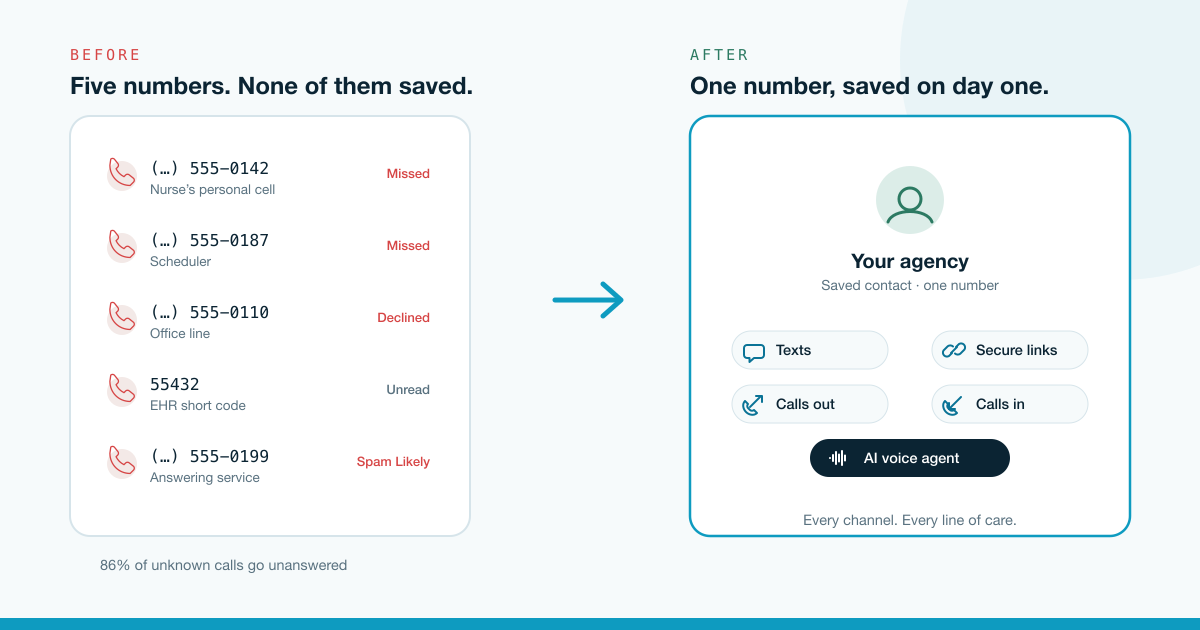
A patient or caregiver opts in once, saves one number, and everything your agency does arrives from it: texts, secure links, calls from the nurse, calls back to the office, and the AI voice agent that answers when nobody can. Many lines of care, one line of communication.
The number is the relationship.
Count the numbers a patient sees from one agency today. The nurse calls from a personal cell. The scheduler calls from the office line. Texts arrive from whichever system sent them. After hours, the answering service calls from a number nobody has ever seen. Every one of them is an unknown caller, and unknown callers lose. Hiya's 2026 State of the Call found that 86 percent of calls from unknown numbers go unanswered, and branded, recognized calls are answered up to 44 percent more often. Apple's iOS 26 Call Screening and Google's call verification now interrogate unknown callers before the phone rings. Both engagement figures are third-party research, cited on our Data and Sources page.
Many organizations have already fixed the outbound half of this: caller ID masking is in place, personal cells are restricted, staff calls show the agency name. The texts, the secure links, the after-hours line, and the callbacks still come from somewhere else, so the patient still sees a crowd. What has been missing is not another per-channel fix. It is one consented thread, on one number, carrying all of it.
A saved contact is the one caller ID that does not depend on any carrier’s or phone’s filter to get through. Every new number you introduce sets that trust back to zero. So the fix is not a better message. It is fewer numbers: one.
Five things, one saved contact.
- ✓Texts. Visit reminders, check-ins, and two-way conversations with the care team, from the number the patient saved on day one.
- ✓Secure links. Forms, consents, eSign, and photo requests open from a text sent by that same number, so a link from a known sender gets opened instead of ignored.
- ✓Calls out. Nurses and schedulers call from their own phones and the patient sees the agency number, never a personal cell (Caller ID Masking).
- ✓Calls in. When the patient calls back, the call lands with the AI voice agent, which captures the reason for the call and transfers it to the on-call nurse by your live on-call schedule.
- ✓The AI voice agent. Nights, weekends, and the busy hour: routine questions answered on the same number, and everything logged to the patient thread like any other touchpoint.
The rule, from the patient's seat: every patient and caregiver has exactly one number for everything the agency does. How many numbers the organization owns is a branding question (one per brand the patient recognizes). How many numbers the patient sees is not negotiable.
And to be plain about what this is: one number is not a separate product you buy alongside the platform. It is the platform, working as one thing: consent capture, caller ID, the voice agent, on-call routing, and the patient thread. What is included and how it is priced is on the pricing page.
One consent, captured at admission.
Consent is captured once, at admission, in the packet or from a QR code (Opt-In Plus), and it names the channels: texts, secure links, and calls from the agency and its care team. A text reply of STOP stops texts and nothing else; a request to stop calls, made on a call, is logged as its own event against calls. Every consent and every revocation, with its timestamp, method, and scope, lands in the Opt-In Report: a documented, exportable record of every consent and revocation. How the rules work, and what the record has to contain, is the first post in this series: Opt in once: the TCPA healthcare exemption, HIPAA texting rules, and one consent record for every channel.
The number on your door is the number.
Your existing published number can be ported in. The number on the building, the business cards, the referral packets, and the magnet on the patient's refrigerator becomes the number that carries texts, secure links, calls, and the voice agent. Nothing to re-print, nothing to re-teach.
The patient moves. The number does not.
If you run a single service line, one number is simply how your agency stays reachable and provable, and everything above applies as written. If you run a continuum, it compounds: a home health patient who transitions to hospice keeps the same number and the same consent; nobody asks the family to opt in again. When care ends and bereavement begins, the caregiver becomes the contact on that same number, and the thread continues. Read alongside our multi-service line and bereavement pages: one platform per organization, one number per brand.
How many numbers do you actually need? Count brands the patient recognizes, not staffing models.
- ✓Franchise: each franchisee is the brand the patient knows, so each runs its own number.
- ✓Brands rolled up under an umbrella: one number per brand; the umbrella is invisible to the patient.
- ✓Shared staff across lines, or dedicated staff per line: either way, one number. Who answers is a routing decision, never a reason to hand the patient another number.
What we are not claiming.
Agencies are early in adopting this, and we do not yet publish outcome data of our own; the answer-rate figures above are third-party research and are cited on our Data and Sources page. The AI voice agent captures and routes; clinicians make the clinical decisions, and it is never a substitute for emergency services. And how broad your admission consent reaches is a question for your counsel: we describe the mechanics, we do not give legal advice.
One Agency, One Number, in four posts.
Questions operators ask first.
Is it literally one phone number for the whole agency?
One number per brand the patient recognizes. A single-brand agency runs one number; an organization with several brands, or branches that carry their own local identity, runs one per brand. From the patient's seat the rule never changes: one number for everything that agency does.
Can we keep the number we already publish?
Yes. The number on your door, your business cards, and your referral packets can be ported in, so the number patients already recognize becomes the one that carries texts, secure links, calls, and the AI voice agent.
What happens when a patient calls the number back?
The call lands with the AI voice agent, which captures the reason for the call and transfers it to the on-call nurse according to your live QliqSOFT on-call schedule. Routine questions are answered without a transfer. The voice agent is never a substitute for emergency services.
Does a patient have to opt in again when they move from home health to hospice?
No. Consent is captured once for the agency and its care team and travels with the patient between service lines; in bereavement, the family member becomes the contact on the same number. Your admission language decides how broad that consent is, so have counsel review it.
See one number on your census
Bring the number you publish today. In 30 minutes we will show how it carries texts, secure links, calls out, calls in, and the voice agent, and what the consent record looks like to a surveyor.