AI in Home Health and Hospice: 7 Takeaways from FUTURE 2026
“AI doesn’t have eyes.” Field notes from the first combined HHCN and HME Business FUTURE Conference in Austin, where the growth conversation stopped being about referrals and started being about hours.


The HHCN and HMEB FUTURE Conference 2026 ran August 26 to 28 at the JW Marriott Austin, the first year Home Health Care News and HME Business combined their two FUTURE events into one. With no booth to manage, we spent three days listening to sessions and to conversations among home health, hospice, home care and HME leaders.
The clearest signal was what nobody asked. None of the sessions we attended explained what AI is or argued that the industry should take it seriously. Every AI session was about implementation: clinician adoption, where the tool sits in the workflow, and what you measure ninety days after go-live. The other shift was in the growth conversation, which moved from referral volume toward clinical capacity, while the CMS moratoria turned compliance into an operating concern rather than a back-office one.
Four weeks. Reported time for clinicians’ preferred recording mode to flip in home health, from about a third favoring in-home recording at the start to a majority of them, as they learn to speak observations the system cannot see.
Reported by StenoHealth from its own deployments. Not independently verified.
Merging the two events put HME leaders on the main stage rather than a parallel program down the hall, before a room of owners, presidents and senior operators plus private equity and M&A advisors. Three tracks ran concurrently, so nobody sees the whole conference; we attended six and reconciled the rest against the agenda.
1. The constraint moved from demand to capacity
For years the growth conversation started with referrals. This year it started with whether you can say yes to them.
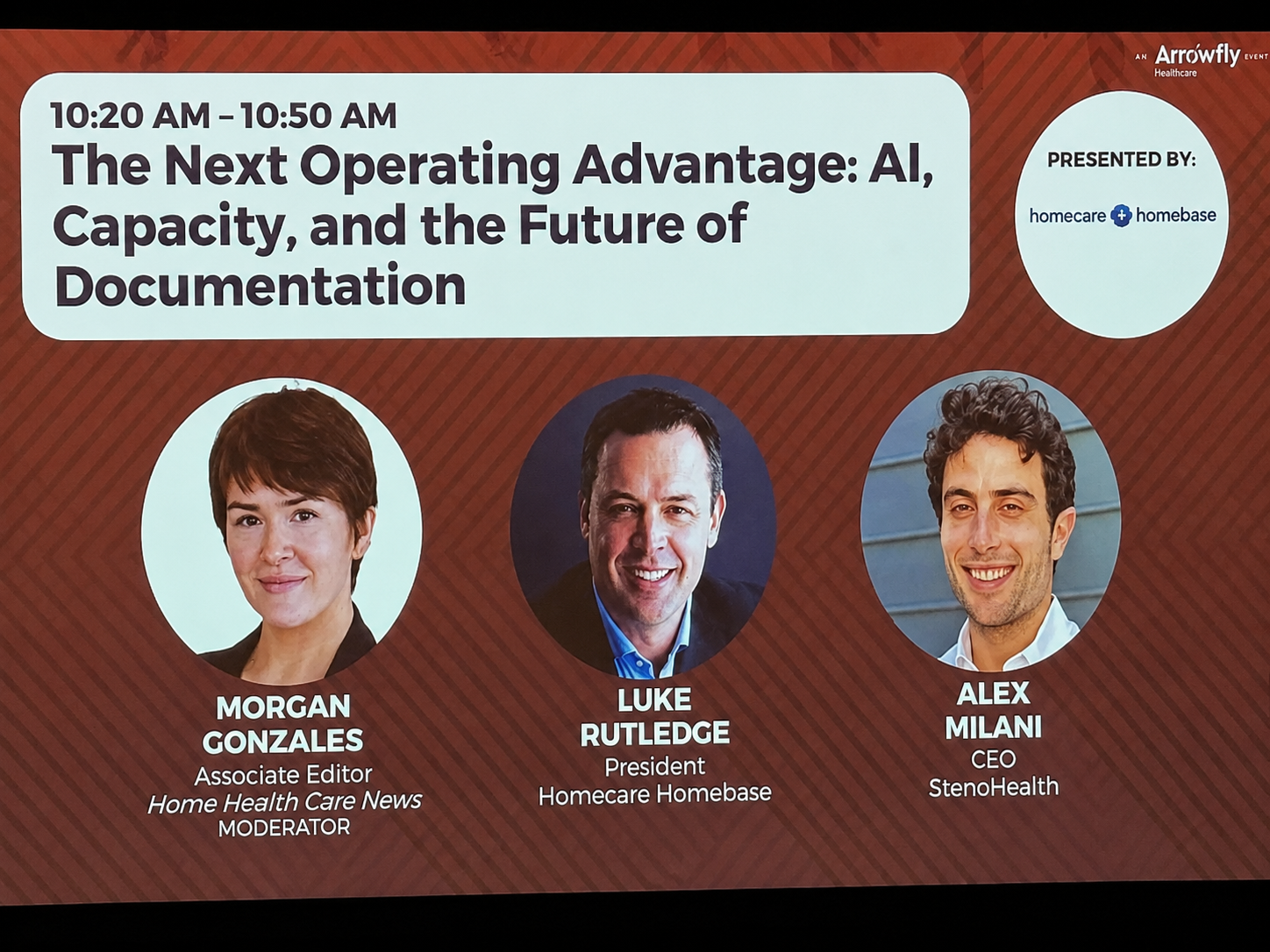
The Next Operating Advantage: AI, Capacity, and the Future of Documentation, presented by Homecare Homebase, put Luke Rutledge and StenoHealth's Alex Milani on stage, moderated by HHCN's Morgan Gonzales. The premise: demand is rising, but growth depends on whether clinicians have time to take more patients and finish complex documentation. Amba's Grow Margin Faster Than Headcount and Claim Health's Built to Scale were built around the same question.
The ceiling on your census is your team's existing hours, which makes anything that adds a screen, a login or a second inbox to a clinician's day a direct drag on growth.
2. The home is not a clinic, and the demo is not the home
Ambient AI that performs well in an exam room does not automatically perform well in a living room, and that gap is a buying question, not a footnote. When a patient sees their physician they are in a small quiet room. Two people. You could hear a pen drop. Home health is the opposite: a clinician drives to a house where dogs are barking, the television is on, family members are in the room. As the stage put it, that is "very different than a demo."
The system has to work out whether it hears the patient, the clinician, a family member or the television. Worth asking vendors directly. Home-based care is not ambulatory care with a longer drive, and tools built on that assumption can struggle in ways a controlled demo never surfaces, as we wrote in The Reality of Field-Based Care Teams.
3. "AI doesn't have eyes," and the adoption curve gets worse before it gets better
The most useful and least intuitive thing we heard: review burden rises at the start of an ambient rollout and drops only when clinicians learn to narrate what the microphone cannot see.
StenoHealth described two recording modes, one inside the home and one where the clinician debriefs in the car afterward. By its own figures, clinicians start out favoring the in-home mode roughly a third of the time, and after about four weeks that preference flips. Those numbers come from one vendor's deployments, so treat the curve's shape as the finding, not the percentages.
The reason became the phrase that stuck: AI doesn't have eyes. It cannot see the blood pressure cuff. If you do not say the reading aloud it does not exist, and a system guessing at an unspoken vital is dangerous. Someone who read a cuff silently and typed the result for fifteen years must learn to narrate. Once they do, StenoHealth reports review burden dropping below where it started.
So plan for it. On the curve presented in Austin, an organization judging a pilot at day fourteen would be judging it near the point where the numbers looked worst.
The panel added the change-management half. It put the time handed back at thirty to forty-five minutes, and said nobody has decided where it goes. Not all becomes visits; some belongs to quality review.
4. Embedded or bolted on: the case that was made, and who made it
Asked whether AI should live inside the EHR workflow or beside it, the Homecare Homebase panel gave two reasons, neither about convenience.
Data integrity. Partner integrations work to a point but never reach full value without direct integration. The failure mode is human: clinicians hopping between apps, unsure what they entered where, validating twice.
Timing. Much of what gets called "integration" is robotic process automation scraping between systems on a delay, and late data arrives after the decision.
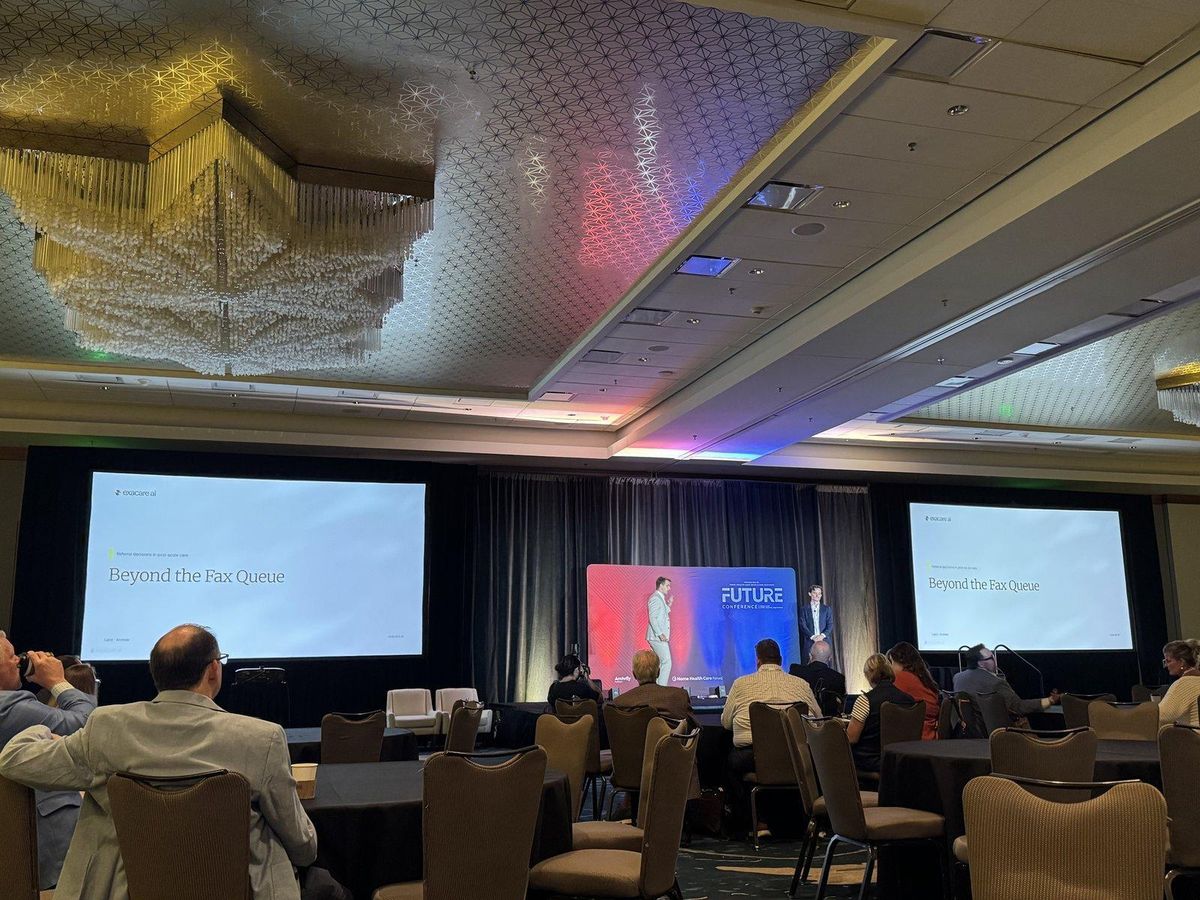
One disclosure, because it was on the slide. Homecare Homebase announced Curate: Scribe in March 2026, an embedded documentation capability built with StenoHealth, the other company on that stage. The reasoning holds up, but the context matters. Exacare ai argued a version of the same case from the main stage in Beyond the Fax Queue.
Beyond the Pilot, with leaders from BAYADA and Compassus, made the related point: buyers ask harder questions now than in 2023. Not "what can this do," but "what does this replace."
5. Compliance stopped being a back-office function
On May 13, 2026, CMS imposed two separate six-month nationwide moratoria on new Medicare enrollment, one for home health agencies and one for hospices, covering new branches and practice locations. They also block re-enrollment after certain non-exempt changes in majority ownership, and can be extended in further six-month increments. Both were in force at the time of writing. A similar February 2026 moratorium hit certain DMEPOS suppliers, which is why the HME half of the room was nodding along.
Three sessions pointed at it, including the main-stage Turning Up the Heat. The tone was strategy more than panic: if you cannot grow by opening locations, you defend the census you have and make every record survive scrutiny.
Which raises a question nobody quite answered. Audit readiness is a documentation problem in the EMR, but much coordination happens outside it, in calls, messages and voicemails that make the full context of a decision hard to reconstruct months later. We covered that gap in The Hidden Impact of Missed Messages.
6. Capital is back, and it is asking harder questions
M&A filled more rooms than any other topic, and the framing had shifted: regulatory exposure is now priced into a deal, not discussed after it. Capital, Consolidation and Comebacks put a private equity firm, a franchise platform and a national provider on the main stage, while Agenda Health's Home Care M&A Insights covered valuation and where deals collapse.
The freeze does not stop states licensing new agencies. It restricts new Medicare enrollment, narrower than it sounds but a real constraint on organic expansion. For operators whose growth plan depended on opening enrolled locations, acquisition may become a more important growth path.
For operators not selling: what makes an agency attractive to a buyer is mostly what makes it run well on an ordinary Tuesday. Clean records, documented coordination, predictable intake, low missed-visit rates, none of which can be built the week a buyer calls.
7. The security bar moved, and most vendor checklists have not caught up
One audience question cut straight to it: now that we are talking about accuracy and efficiency, are we confident the security questions have been answered?
The panel argued that patch windows once measured in seven or thirty days increasingly need to be measured in hours, with twenty-four raised as the benchmark, because AI scans PHI and access controls have to hold.
HIPAA and SOC 2 came up as the baseline, with two standards raised beyond them: ISO 27001 for information security and ISO/IEC 42001, the management system standard for organizations that build and deploy AI. Neither is required in home-based care today, and neither substitutes for your own diligence. They were offered as where the questions are heading.
All of it paired with the session's governing principle: the clinician's license is on the line. Do not black-box what the AI heard, show a confidence level, surface findings as insights not conclusions.
As one panelist put it: clinicians trust AI that hands them a decision, and distrust AI that makes one.
What we kept thinking about on the drive home
Capacity. Environment. Adoption. Integration. Enforcement. Trust. Underneath each, one root cause: information that never reached the right person at the right time.
One point from the Thursday fireside chat is worth returning to. What pushes care into the home is arithmetic, not preference: CMS projections put national health spending at 18.0 percent of GDP in 2024, rising to 20.6 percent by 2034. The CDC attributes about 90 percent of that spending to people living with chronic and mental health conditions. The model described for absorbing that was structured family caregiving: family members trained and paid to deliver care at home, backed by technology and periodic nursing visits.
If that is where the model is heading, a growing share of the people delivering care will never touch your EHR. Ambient documentation captures the encounter; it does nothing for the days between, when a family calls on a Saturday or a patient misreads discharge instructions. None of it becomes a note until someone puts it there, the same gap we examined in IDG preparation in hospice.
That gap is what QliqSOFT has worked on since 2011: QliqCHAT for coordination inside the care team, Quincy for conversations with patients and families between visits. None of it adds Medicare enrollments, branches or nurses. What it changes is how much of the coordination between visits gets done without adding to anyone's day.
What to take back to your own operation
- Write your ninety-day scorecard before the pilot starts. Decide whether recovered time becomes visits, quality review or earlier end-of-day.
- Don't draw conclusions from an ambient pilot at day fourteen. On the Austin curve, that is near its worst point.
- Ask vendors about the home specifically. Background noise, multiple speakers, observations nobody says out loud.
- Test the integration claim. Direct integration or robotic process automation on a delay, and when data lands.
- Inventory where coordination actually happens. Decisions made outside the record are hardest to reconstruct.
- Update the security questionnaire. The panel pointed at patch windows, plus ISO 27001 and ISO/IEC 42001 alongside HIPAA and SOC 2. Set your own thresholds with your security team.
- Run the agency the way a buyer would want to find it. Clean records, documented coordination, predictable intake, low missed-visit rates.
If we crossed paths in Austin, or if we didn't
If this maps to what you are working through, we will walk your team through where coordination happens in your organization today, and what an audit trail would need to capture. Thirty minutes, your workflows, no slides.
Request a demo or call (866) 295-0451
If you were in Austin and read this differently, we would rather hear it.
Frequently Asked Questions
What are the 2026 CMS enrollment moratoria for home health and hospice?
On May 13, 2026, CMS imposed two separate six-month nationwide moratoria on new Medicare enrollment, one for home health agencies and one for hospices, covering new branches and practice locations. They also block re-enrollment after certain non-exempt changes in majority ownership, and they can be extended. A similar moratorium covering certain DMEPOS suppliers was announced in February 2026. State licensure of new agencies is not affected; what is restricted is new Medicare enrollment.
How do the CMS moratoria affect growth plans?
If your growth plan depended on opening newly enrolled locations, that route is closed while the moratoria are in force. Operators described two responses in Austin: defend the census you already have and make sure every record survives scrutiny, and treat acquisition as a more important growth path than it was. How much that actually drives deal activity will vary by market and by how long the moratoria last.
Why does ambient AI adoption get worse before it gets better?
Because the behavior change comes before the payoff. In the first weeks clinicians are still learning to narrate observations aloud, so the notes need more correction and review burden goes up. Once narration becomes habit, review burden drops below where it started. StenoHealth reported the flip happening at around four weeks in its own deployments, which is vendor-reported and not independently verified. The practical implication is that a pilot evaluated at day fourteen is being evaluated near its worst point.
Should AI documentation be embedded in the EHR or run alongside it?
The case made at FUTURE 2026 for embedded rested on two arguments. Data integrity: partner integrations work to a point but never reach full value without direct integration, and clinicians moving between apps end up validating the same data twice. Timing: much of what is called integration is robotic process automation scraping between systems on a delay, and data arriving late arrives after the decision. Note that the session making this case was presented by an EHR vendor with an embedded product, so weigh the argument on its merits.
What security standards should home-based care providers ask vendors about in 2026?
HIPAA and SOC 2 were treated as the baseline. Two standards were raised beyond them: ISO 27001 for information security management and ISO/IEC 42001, the management system standard for organizations that build and deploy AI. Neither is required in home-based care today, and neither replaces your own diligence. Patch windows also came up, with the panel arguing that cycles once measured in seven or thirty days increasingly need to be measured in hours, with twenty-four hours raised as a benchmark.
Reported from the HHCN and HMEB FUTURE Conference, JW Marriott Austin, August 26 to 28, 2026. We attended six sessions across two days. Session titles, speakers, sponsors, and program structure are drawn from the published agenda and from photographs taken on site. Positions described here are paraphrased from session notes and attributed to the panels and presenting organizations rather than to individual speakers. National health spending and chronic condition figures are drawn from CMS National Health Expenditure data and the CDC rather than from session remarks. Adoption and time-savings figures presented in vendor sessions are vendor-reported and have not been independently verified. Sessions we did not attend are named but not characterized.
Writes about home-based care operations and the technology that supports coordination between visits.