Hospice Software for Communication & Family Engagement
A QR magnet on the refrigerator connects families to your team in one scan. One IDG Channel that preps itself. Thirteen months of bereavement engagement. QliqSOFT keeps your team connected to every patient and family through the moments that matter most.
What doctors say about the platform
“We needed a way to protect patients and staff while providing this care... I would strongly recommend this to other companies.”
“...user-friendly for my geriatric patients. I would highly recommend the platform for anyone looking for a HIPAA-compliant telemedicine video conferencing tool.”
The biggest regulatory shift hospice has seen in years is here.
HOPE replaced the Hospice Item Set, the CAHPS survey was revised, and CMS oversight has never been tighter. Each change grades how well your team, your patients, and their families stay connected.
HOPE runs on a 2-day clock
Moderate or severe symptoms at Admission, HUV1, or HUV2 trigger an in-person Symptom Follow-up Visit within two calendar days, holidays included. Miss the reporting bar and the penalty is a 4-point cut to your annual payment update.
CAHPS grades the family's experience
The Family Caregiver Survey Star Rating is public, and the revised survey adds care preferences and cultural needs. Nationally, the weakest score is training families to care for their loved one, the question is whether yours will be different.
Scrutiny is the new baseline
The Special Focus Program puts underperformers under intensified survey scrutiny, with termination on the table. Documented, auditable communication across every episode is no longer optional.
Every one of these turns on communication, between your team, your patients, and their families. That's what we do.
The refrigerator magnet that replaces the phone tree.
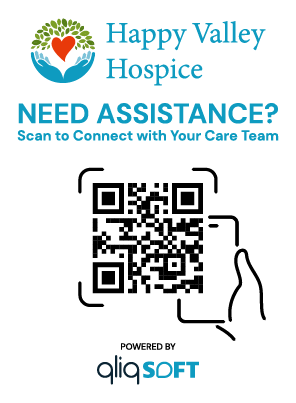
At admission, your care team places a QR magnet on the refrigerator, right where families stand at 4 AM. One scan connects the caregiver, triages the need, and reaches your team. No phone calls. No hold music. No app to download or password to remember.
- ✓Caregiver scans → triaged → connected to the right member of the care team in moments
- ✓Every exchange lives in a single thread, review-ready for the IDG, audit-ready for the surveyor
- ✓Works for any family member with a phone camera, the daughter across town can scan a photo of it too
- ✓Your logo, your branding, a daily physical reminder of who's caring for their loved one
Never lose an SFV to a scheduling gap.
Two calendar days is tight when your field team is at capacity. The moment an assessment flags moderate or severe symptoms, your team needs to know, schedule, and confirm, before the window closes. That's a coordination problem, and coordination is what QliqCHAT was built for.
- ✓Instant team alerts in QliqCHAT when a HOPE assessment triggers an SFV requirement
- ✓Visit scheduled, assigned, and confirmed with the family by text, same day
- ✓Scored family check-ins between visits, aligned to HOPE’s symptom-impact scale, so a rising score maps straight to your SFV thresholds
- ✓A documented, time-stamped trail for every HUV and SFV, audit- and QAPI-ready
IDG prep that writes itself.
The Conditions of Participation require your IDG to review every plan of care at least every 15 calendar days, and surveyors check that changes in patient status were communicated to the IDG and documented. QliqCHAT's IDG Channel does both automatically: it's one feed that captures every change-of-condition report from across all of your Patient-Centered Group Chats, your whole census, one channel. Related reading: Why hospice teams spend so much time preparing for IDG
- ✓When any team member reports a change in condition in any patient's group chat, it auto-posts to the IDG Channel, no re-documentation, no chart mining
- ✓IDG prep becomes reading one feed, not opening fifty threads, every status change across the census, in order, in one place
- ✓Built-in escalation: urgent changes alert the RN coordinator and on-call in real time
- ✓Each entry links back to its Patient-Centered Group Chat, which is tied to the patient's EMR record and synced as Collaboration Notes, so IDG communication at every status change lives in the clinical record, exactly where surveyors look
CAHPS asks the family if they felt supported. Make the answer easy.
The survey arrives months after the loss, but the answers are written during the episode, in every reachable moment, every explained medication, every update in the family's own language. The weakest CAHPS score nationally is caregiver training. That's precisely where text-based support shines.
- ✓Caregiver education delivered at teachable moments, short guides and videos by text, not a binder on the counter
- ✓Real-time translation both ways, honoring the cultural and language needs the revised survey now asks about
- ✓Two-way family line: questions answered and symptoms triaged before they become 2 AM panic calls
- ✓Proactive updates after every visit, so the whole family, near and far, stays informed
Tuck-in Thursdays, automated. Every family. Every week.
Hospices have known for years that Thursday tuck-in calls work. One hospice's volunteer tuck-in program cut calls to its weekend on-call nurses by 66%, leaving true emergencies as the only calls that remain (Hospice Management Advisor, 2010). But phone-based programs cap out at volunteer headcount, many calls go to voicemail, and the logs live on paper. Quincy runs the tuck-in by text, to every caregiver, every Thursday evening, at any census. Related reading: supporting families between visits
- ✓Thursday-evening check-ins to all caregivers at once: medications, supplies, equipment, symptoms, worries
- ✓Families answer on their own time, no missed calls, no voicemail dead-ends
- ✓Needs route to the right team member instantly; refills and deliveries land Friday, before the weekend does
- ✓Symptom concerns escalate to the RN in QliqCHAT, the crisis that becomes a 911 call, a revocation, and a live discharge never gets the chance
- ✓Every response auto-documented in the thread, and your volunteers are freed for bedside presence and 11th-hour vigils, the work only humans can do
Referrals arrive at 4:45 on a Friday. Answer every one.
Census is won in the hours after a referral, and lost to voicemail. AI voice agents answer every call, night and weekend; intake moves by text; and consents are signed before the admission nurse leaves the office.
- ✓AI voice agents answer every after-hours inquiry, capture the full referral or concern, and route the caller to the right available expert via your live QliqSOFT on-call schedule
- ✓Referral-to-admission automation: consents, election forms, and e-signatures completed by text
- ✓Snap to PDF, liaisons capture the referral packet at the hospital bedside as a clean PDF, straight into the patient thread; admissions starts working it before the liaison reaches the parking lot
- ✓On-call schedules live in QliqCHAT, the voice agent always knows who’s on tonight, so the admission visit gets scheduled on the first call
- ✓Caller ID masking, nurses and chaplains call families from personal phones showing your hospice’s number; and with on-call routing, when the family calls or texts back at 2 AM, it reaches whoever is on tonight, never an off-duty phone, never an unanswered goodbye
- ✓Speed-to-admit your referral sources can feel, and remember
Care that doesn't end when the episode does.
The Conditions of Participation require an organized bereavement program with services available up to one year following the death. Thirteen months of gentle, automated text outreach doesn't just meet that bar, it carries every family through the first anniversary, the hardest day of the year.
Referral & Admission
Same-day consents and election forms by text; the family's line opens on day one. Deep dive: the first 72 hours
Quincy + AI VoiceOn Service
Thursday tuck-ins, caregiver education, HUV & SFV coordination, own-language updates. Deep dive: the first two weeks
Quincy → QliqCHATFinal Days
Intensified support and presence, the visits and answers that define how families remember you. Deep dive: the last 14 days
QliqCHAT + On-CallThe Loss
Condolences, practical guidance, and a gentle introduction to what support comes next. Deep dive: bereavement outreach
Bereavement CenterMonths 1 to 13
Plans in three risk lanes that move as grief changes, rescreens on a schedule, ebooks, groups, and remembrance dates, no phone call required.
Bereavement CenterThe CoPs require a system of communication. This is it.
42 CFR §418.56(e) requires every hospice to develop and maintain a system of communication and integration across all disciplines. Most hospices assemble one from phones, faxes, and sticky notes. Yours can be purpose-built. Related reading: Why communication breakdowns are the #1 hidden cost in hospice care
Coordination of services A system of communication ensuring the IDG directs and coordinates care, with ongoing information-sharing between all disciplines. ✓QliqCHAT connects every discipline, nurses, aides, social workers, chaplains, physicians, in one secure, documented system.
Plan of care review Plan of care reviewed as the patient's condition requires, and no less than every 15 calendar days, with status changes communicated to the IDG and documented. ✓The IDG Channel auto-posts every change of condition the moment it's reported, time-stamped, escalated, and ready for the 15-day review.
Bereavement counseling An organized bereavement program with services available to the family up to one year following the death of the patient. ✓13 months of automated, compassionate engagement, one month beyond the requirement, through the first anniversary.
Clinical record Surveyors expect retrievable documentation of communication, with families, between disciplines, and with the IDG at status changes. ✓Every magnet scan, message, and escalation lives in a single searchable thread, review-ready and audit-ready.
Regulatory references are summaries for general information and are not legal advice.
Whoever you are in the organization, this is your win.
Illustrative role composites drawn from real customer conversations, not attributed quotes. Named, verified customer results and quotes appear throughout this site.
We haven't missed an SFV window since go-live. The alert fires, the visit gets scheduled, and the documentation trail builds itself.
After-hours referrals used to go to voicemail. Now every call is answered, and our weekend admissions are up because of it.
Our family caregiver star rating moved for the first time in three years. Families tell surveyors they always knew what was happening.
Bereavement outreach used to depend on whoever had time to make calls. Now every family hears from us for thirteen months, and they write back.
Works with the EMR you already run.
The year after is still your responsibility. Make it count, and make it visible.
Mandated, and unreimbursed
CMS Conditions of Participation require bereavement services to be available for up to one year after every death, but the per-diem stops at death. The program is a compliance obligation and a cost center, and surveyors expect documented risk assessment and follow-through, not a mailing log. And it scales with deaths, not census: a five-day stay creates the same bereavement obligation as a six-month stay.
Mail proves sending, not supporting
Cards at intervals cost rising postage and return no signal: who opened, who is struggling, who needs a counselor. Older adults are the least likely to seek grief support on their own, which means silence is not reassurance, it is missing data. When mail still matters, the Bereavement Center builds the monthly run from each plan and flags only the exceptions.
Text support works, and it is measured
In a published study of text-based grief support delivered as a hospice benefit, 13-month program retention was 86% and 73% of bereaved family members rated it "very helpful." (Levesque et al., OMEGA: Journal of Death and Dying, 2023) Grief support by text is not a compromise; for this population it is the channel that stays.
Grief changes, so the plan moves
A risk rating set during the patient's stay is one snapshot. Rescreens on a schedule suggest when someone should move to a closer-support lane, and your coordinator decides, so the plan follows the person instead of the calendar.
The Bereavement Center runs the whole arc in one place. Contacts arrive from your EMR or an import and wait in a review queue until their record is clean. Each person gets a 13-month plan in a high, moderate, or low risk lane, with check-ins, grief education, and ebooks by text through the milestone months, holidays, the loved one's birthday, and the anniversary. Rescreens suggest lane changes for your coordinator to confirm, unanswered screens fall back to a call, and the AI never calls anyone at high risk. Every touch is recorded as planned versus delivered, so the program your CoPs require is also the program your surveyors can see. Priced per survivor per month, and discharged families never bill as active patients; see how pricing works and the Bereavement solution bundle. Related reading: Is your bereavement program still mailing into the void?
Short stays don't shrink the obligation. They multiply it.
A five-day stay creates the same bereavement obligation as a six-month stay. The shorter your average length of stay, the faster patients turn over, and every death adds survivors to a program that runs for 13 months after the census stops counting them.
What does IDG prep cost you every two weeks?
Hospice communication, answered.
What communication software do hospice agencies use for their care teams?
Many hospice agencies use a secure clinical messaging platform alongside their EMR, so nurses, aides, social workers, chaplains and physicians can coordinate without personal texting or phone tag. QliqSOFT's QliqCHAT is built for hospice teams. Each patient can have a group chat tied to their EMR record, and on-call schedules live in the app. Change-of-condition reports post automatically to an IDG Channel, and urgent changes alert the RN coordinator and on-call staff in real time.
How do hospice organizations automate communication with patients and families?
Hospices automate the routine, predictable touches and leave clinical judgment with staff. That includes consents and election forms by text, visit confirmations, caregiver education, weekly check-ins and bereavement follow-up. With Quincy by QliqSOFT, families reach the care team by scanning a QR magnet on the refrigerator. Thursday tuck-in check-ins go to every caregiver by text, symptom concerns escalate to the RN in QliqCHAT, and every response is documented in one thread.
What should a hospice look for in communication software?
Look for secure messaging across every discipline, on-call routing for after-hours messages, two-way texting with families, EMR integration, a signed Business Associate Agreement and a documented communication trail. The Conditions of Participation (42 CFR §418.56(e)) require a system of communication across disciplines. QliqSOFT covers staff and family communication on one platform: QliqCHAT for the care team, Quincy for families and AI Voice Agents for after-hours calls. It is HIPAA compliant and SOC 2 Type II attested, and a Business Associate Agreement is included with every customer.
Does hospice communication software work with our EMR?
It should. Surveyors expect communication to be documented, so messages that stay outside the clinical record create extra work. QliqSOFT works with Homecare Homebase, Axxess and WellSky, and connects through FHIR, HL7, Open API and SFTP/CSV. QliqCHAT patient group chats can be tied to the patient's EMR record, and conversations sync back as Collaboration Notes.
Meet the 2-day clock. Earn the family's stars.
In a 30-minute demo mapped to your hospice's workflows, intake, HOPE visit coordination, family communication, after-hours, bereavement, we'll show you exactly where the burden lifts.