How Much Time Are Your Aides Losing Per Visit? (And What It's Costing You)
April 22, 2026
For most hospice organizations, Aide productivity loss is invisible on paper but very visible on payroll. Here is how to measure it and what to do about it.

Most hospice organizations track visit volume, mileage, and documentation compliance. Very few track how much of each visit window is consumed by communication tasks that have nothing to do with direct patient care. That untracked time is one of the largest controllable costs in hospice operations, and it compounds across every Aide on your roster, every day.
The challenge is that this cost is structurally invisible. It does not show up as a line item. It lives inside the visit window, absorbed into the daily reality of how Aides actually spend their time when the care plan does not account for the minutes it takes to track down a Nurse for a clinical question, or the time spent leaving and waiting on voicemails before a medication concern gets resolved.
When hospice leaders look at Aide productivity, most are measuring the wrong things. The question is not whether your Aides are completing their scheduled visits. The question is how much of each visit window is being consumed by communication friction, and what the cumulative cost of that friction is across your census.
Where the time actually goes
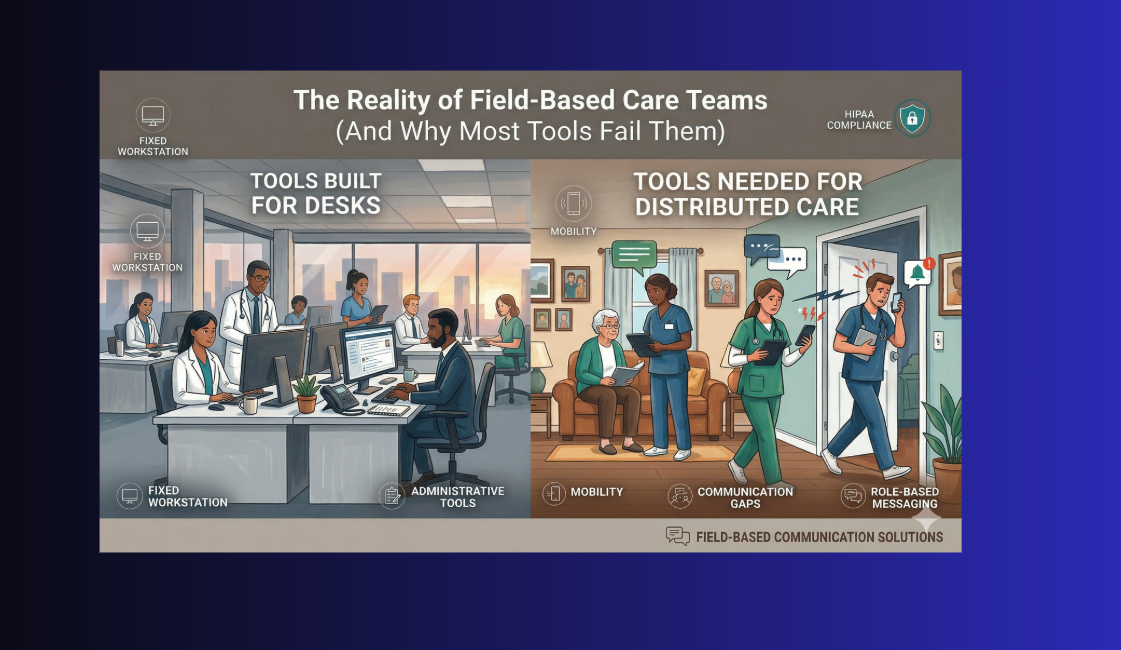
The communication tasks consuming Aide time are not unusual or unexpected. They reflect the routine logistics of field-based hospice work. What tends to make them costly is the infrastructure, or absence of it, that Aides are working through to get them done. The time loss tends to cluster around a few consistent patterns:
Escalation attempts to the supervising Nurse
When an Aide observes a clinical change, a skin integrity concern, increased pain, a change in patient responsiveness, the path to reaching the supervising Nurse often runs through a personal cell number, a voicemail system, and a wait. Every minute spent waiting comes out of the care time in the visit window.
Shift handoff communication
At the start and end of each visit, Aides need to pass and receive clinical context. What changed since the last visit. What the family reported overnight. What the Nurse noted on the previous visit. In many organizations, this context lives in EMR notes that Aides may or may not be able to access efficiently from a mobile device, supplemented by informal texts and verbal catch-ups. The result, in practice, is that Aides frequently begin visits without complete situational awareness, and spend time during the visit reconstructing context they should have had before arrival.
Family communication and coordination
Hospice Aides are often the family's most frequent point of contact. Families ask questions, raise concerns, and request updates, and Aides are the ones present to receive them. Without a structured channel for routing family concerns to the appropriate clinical team member, Aides absorb the communication burden directly, either managing it themselves beyond their scope of practice or spending time escalating it through informal channels.
Documentation catch-up during or after visits
In organizations with fragmented communication tools, Aides often spend extra time on documentation correction and addenda, updating notes to reflect information that arrived after the initial entry because the clinical picture was still evolving when the visit ended. This is a downstream consequence of communication latency during the visit itself.
What it actually costs: a working model
The financial impact of Aide communication friction is straightforward to model once you have your own time data. Run a short time study across a sample of shifts and log the minutes Aides spend on escalation attempts, status updates, and handoff communication. Then:
- Multiply the average minutes lost per Aide per shift by your number of Aides to get the hours lost per day.
- Multiply by your working days to get the hours lost per year.
- Multiply by your average Aide hourly rate to get the annual labor cost.
Use your own payroll and scheduling data rather than industry averages. Results vary with team size, visit frequency, wage rates, and the communication workflows you have in place. Organizations with higher census or more complex on-call structures will generally see larger figures.
The annual labor cost from step 3 does not include the cost of preventable escalations that become emergency visits, the downstream impact on Nurse and Care Coordinator time spent managing poorly routed communications, or the effect on Aide retention when staff feel unsupported by the communication tools they are given. The direct labor cost is the floor, not the ceiling.
The retention angle most organizations are underweighting
Communication friction also shows up in retention. When Aides cannot reach a supervisor or get real-time clinical support, the job gets harder, and that frustration can push people out. Every departure brings recruiting, onboarding, and the time it takes a new Aide to ramp up.
Put your own replacement cost per Aide next to the productivity model above. The two numbers are connected, and together they show what communication friction is really costing you.
A scenario that most hospice leaders recognize
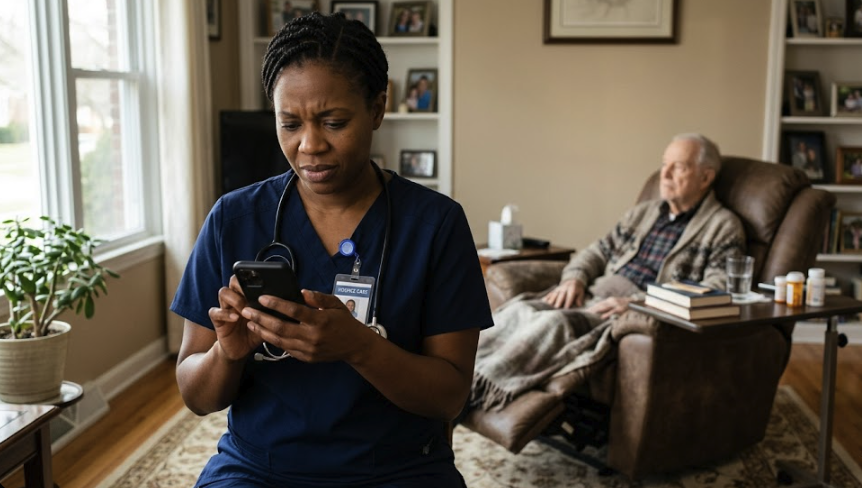
An Aide arrives at a patient's home at 9:00 AM for a scheduled two-hour visit. Before entering, she checks her phone for any updates from the overnight Nurse. There are none in the EMR. She sends a text to the Nurse's personal cell. No response yet.
During the visit, she notices a new skin integrity concern on the patient's heel. She calls the Nurse. Voicemail. She texts again. At 9:34 AM the Nurse calls back. The clinical question takes four minutes to resolve. The Aide documents the concern after the call, adding an addendum to the visit note.
The patient's daughter asks the Aide about a medication change she heard the Physician mentioned at the last visit. The Aide does not have that information. She tells the daughter she will follow up. She makes a note to herself to contact the Care Coordinator after the visit.
By the time the Aide leaves at 11:10 AM, approximately 28 minutes of the visit window was spent on communication tasks: waiting on the Nurse, managing the escalation, fielding the family question, and completing documentation catch-up. The visit itself was clinically appropriate. The infrastructure around it was not.
This is not an uncommon scenario. It reflects what many hospice Aides experience on a typical shift. The individual moments are small. The cumulative operational and financial impact across a full roster is meaningful.
What changes when the communication infrastructure is right
Organizations that have addressed Aide communication infrastructure tend to see change in a few consistent areas. The improvements are not dramatic single events; they are cumulative shifts in how the daily work actually flows:
- Escalation response time drops significantly. When Aides can reach the on-call Nurse by role rather than by personal cell number, the wait for a clinical answer gets much shorter.
- Visit start quality improves. When shift handoff context is delivered through a real-time message thread rather than reconstructed from EMR notes, Aides arrive at visits with accurate, current clinical context rather than building it from a documentation trail.
- Family questions route correctly. When Aides have a structured channel for passing family concerns to the Care Coordinator or Nurse, they spend less time managing communications outside their scope of practice and more time on direct patient care.
- Documentation is more accurate. When clinical decisions are made in real time with all parties in the loop, Aide documentation reflects the actual visit rather than a reconstruction of it, reducing addenda and reducing compliance risk.
Where QliqSOFT fits into this picture
The productivity loss described in this post is not primarily a staffing problem or a training problem. It is a communication infrastructure problem, and that means it is solvable at the infrastructure level. Organizations that have quantified their Aide communication overhead and addressed it with purpose-built tooling consistently find that the time savings translate directly into recoverable clinical capacity.
QliqSOFT's QliqCHAT gives Aides a direct, HIPAA-compliant channel to their supervising Nurse and Care Coordinator, with role-based routing that eliminates the personal-cell-number escalation chain. On-call routing adapts to your schedule automatically, so the Aide in the field always reaches the right person without needing to know who is covering. Every escalation is logged, every handoff is documented, and the communication record travels alongside the clinical record rather than living in a separate chain of personal messages. For organizations tracking Aide productivity and looking for measurable ways to recover visit capacity, the communication layer is frequently where the largest recoverable gains are found.
The communication time your Aides lose every day is not fixed overhead. It is addressable. The organizations finding relief from it are the ones that have stopped treating communication infrastructure as a background operational detail and started treating it as a clinical productivity lever.
Frequently Asked Questions
Find answers to common questions about this topic.
How much time do hospice aides typically lose to communication tasks?
It varies by organization, and most do not measure it. Log the minutes aides spend on escalation attempts, status updates, and handoff communication across a sample of shifts to get your own baseline.
What is the financial impact of aide communication inefficiency?
Multiply the minutes each aide loses per shift by your aide headcount, your working days, and your average aide hourly rate. That gives the direct labor cost, before turnover costs or preventable escalations.
What are the main communication challenges facing hospice aides?
The primary challenges include difficulty reaching supervising nurses, incomplete shift handoff information, managing family questions outside their scope, and documentation catch-up due to communication delays.
How does communication friction affect aide retention?
Difficulty reaching a supervising nurse and a lack of real-time clinical support make the job harder and can contribute to burnout and turnover.