What Your Bereavement Coordinator Knows and the Boardroom Doesn't
Five questions a hospice leader should be able to answer about bereavement, why the coordinator can and the report cannot, and what real visibility looks like.
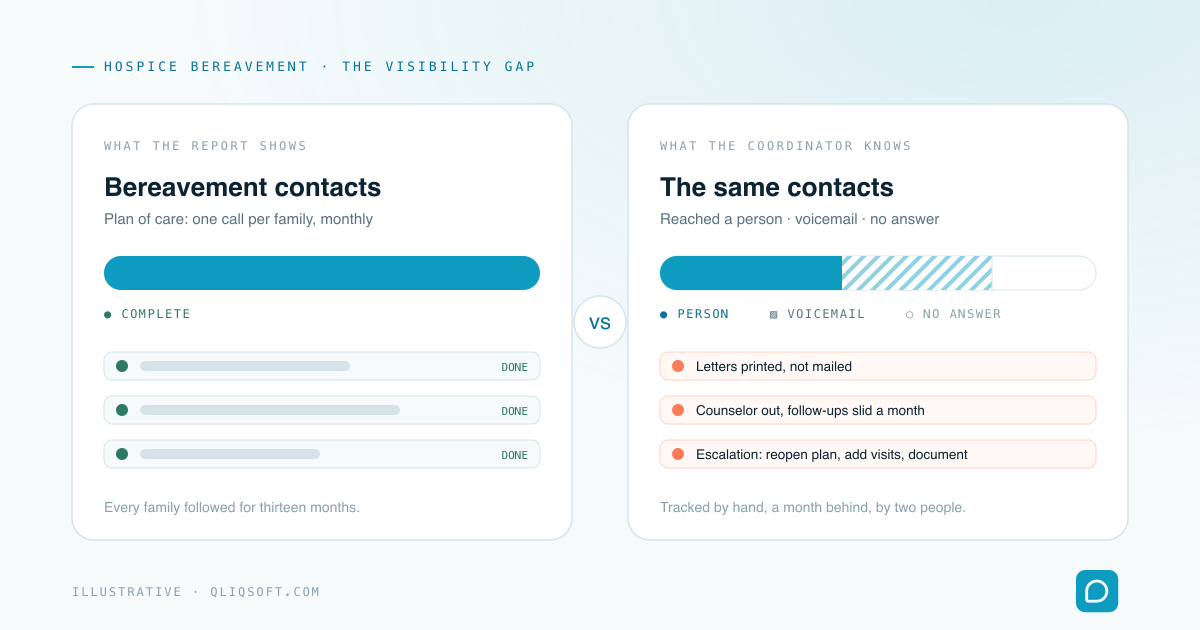
I spend most of my week in discovery calls with hospice teams about their bereavement programs. The calls have a shape by now. A senior leader joins, sometimes two. So does the person who actually runs the program: a bereavement coordinator, a director who still does the tracking herself, a clinical support lead. And somewhere in the first twenty minutes, the same thing happens. The person closest to the work describes, in specific and unflinching detail, exactly where the program is fragile. And the people above her hear some of it for the first time.
Nobody is hiding anything. That is the point of this post. The gap between what leadership believes about its bereavement program and what the coordinator knows is structural, and it shows up in program after program regardless of size, EMR, or how much the leaders care. Below are the five questions I have learned to ask, why they are so hard to answer, and what it would take to answer them.
Why the gap exists in the first place
Bereavement is small, mandated, and unbilled. It runs at roughly 3.6 percent of home hospice staffing by the National Alliance for Care at Home's own staffing framework, it is required by the Conditions of Participation for at least a year after every death, and it produces no revenue event that would force a report to exist. A 2026 review in the journal Omega concluded that hospice bereavement programs in the United States still operate without national standards. Put those together and you get a program that everyone agrees matters, that a very small team runs by hand, and that no dashboard was ever built to describe.
Bereavement is small, mandated, and unbilled. It runs at roughly 3.6 percent of home hospice staffing by the National Alliance for Care at Home's own staffing framework, it is required by the Conditions of Participation for at least a year after every death, and it produces no revenue event that would force a report to exist. A 2026 review in the journal Omega concluded that hospice bereavement programs in the United States still operate without national standards. Put those together and you get a program that everyone agrees matters, that a very small team runs by hand, and that no dashboard was ever built to describe.
The result is a perception gap that healthcare in general knows well. In one survey, 95 percent of healthcare leaders believed they had provided sufficient mental health resources for staff; 21 percent of clinicians agreed. Bereavement is where that pattern lands hardest in hospice, because the people who could correct the picture are busy doing the work by hand.
Five questions a hospice leader should be able to answer
1. How many bereaved family members did we serve this year?
It sounds like the easiest number in the building. In practice, the answer is often a spreadsheet the coordinator updates when she can, a month or two behind, sometimes not at all when a colleague is out. Leadership hears "we follow every family for thirteen months" and reasonably assumes a count exists. When I ask for it, the honest answer is frequently that no one can produce it without a week of work. If you cannot say how many families you served, you cannot say whether the program is working, and neither can anyone above you.
2. What share of our "completed" contacts were conversations, and what share were voicemails?
Every program I talk to logs contacts. Very few distinguish between a call that reached a grieving person and a call that reached their voicemail. On paper, both are complete. In the life of the family, only one happened. When leadership reviews contact completion and sees a healthy percentage, that number can be materially overstated, and no one is misrepresenting anything: the tracking simply never had a field for it. The Conditions of Participation require a bereavement plan of care that names the services and their frequency. A plan that says a monthly call, and a record that says a monthly voicemail, is the gap a surveyor reads.
3. What happens to follow-through when one counselor is out for a week?
Most bereavement teams are two or three people carrying a caseload that runs to hundreds of families, because a hospice's bereavement census scales with deaths, not with patients, and every death starts a thirteen-month clock. That is a single point of failure by design. Coordinators tell me plainly that a week of PTO, or a new hire who needs coaching, puts the whole program in a hole it takes weeks to climb out of. Leadership rarely sees the hole because the letters that did not go out and the calls that slid a month leave no trace in the reports they get. Some programs have told me they are weighing whether to cut planned touches simply to keep up with the current flow, and they say it almost in passing.
4. When a family shows risk, how many steps does escalation take?
The purpose of thirteen months of contact is to notice the family that is not okay. Ask what happens when a coordinator notices, and the answer is often a process that requires reopening the plan of care, adding visits or calls, and then documenting each one, all by hand, all by the same person who is already behind on the tracking. A cumbersome escalation path is a quiet way for the most important part of the program to fail, and it is invisible upward, because leadership sees a policy that exists, not a workflow that nobody has time to run.
5. Are our volunteers saving the coordinator time, or costing it?
Medicare requires hospices to source at least 5 percent of patient care hours from volunteers, and bereavement calling is a natural place to put them. It can also become an administrative program of its own: assigning families, training callers, collecting notes, and re-entering them. More than one program has told me their volunteer pathway generates more coordinator time than it returns. That is not a reason to stop using volunteers. It is a reason to know the number, and almost no one does.
What visibility actually looks like
None of these five questions is a criticism of the people running the program. Every coordinator I meet knows the answers in her bones; what she lacks is the bandwidth to turn what she knows into a report, and the tooling that would produce one as a byproduct of the work instead of a separate job. So when leadership tells me the program is tracked in the EMR, I believe that they believe it. The coordinator on the same call usually has a more precise view.
The programs that close the gap tend to do three things. They reach every family automatically, on the family's phone, in the family's language, so baseline coverage does not depend on how many hours the team had that week. They let the data say who needs a person: the family that stops responding, or whose check-ins signal complicated grief, surfaces on its own and counselor time goes there. And they get a record of every touch as a byproduct, which is what turns "we follow every family" into a number a leader can stand behind, and a surveyor can read. That is how we built Quincy for bereavement, and it is why the conversation about it is usually less about saving staff time than about seeing the program for the first time.
If you lead a hospice, try the five questions on your own program this week. If you can answer all five from a report, you are ahead of nearly everyone I talk to. If you cannot, ask your coordinator. She knows. The work is giving her a way to show you.
What does Medicare require of a hospice bereavement program?
The Conditions of Participation require hospices to provide bereavement services to families and others in the bereavement plan of care for up to one year after the patient's death, based on an assessment of needs, with a plan that states the services to be offered and how often. Most programs run thirteen months to cover the first anniversary.
Why is bereavement so hard for hospice leadership to see?
It is a small, mandated, unbilled program, about 3.6 percent of home hospice staffing, with no revenue event that forces reporting and no national standards for what to measure. Coordinators track it by hand and have little bandwidth to turn that tracking into reports, so leadership's picture is often incomplete through no one's fault.
How does automation change what leadership can see?
When every family is engaged automatically and every touch is recorded as a byproduct, the program produces its own numbers: families served, live conversations versus unanswered outreach, who needs a counselor now, and a documented record for surveyors. Counselor time then goes to the families the data says need it.

Director of Sales at QliqSOFT. Leads discovery and evaluation conversations with home health and hospice organizations, including their bereavement, intake, and care-team communication programs.